AI
AI

A recent article in The Atlantic ran under the blunt headline, The End of Reading Is Here. According to the piece, research from the National Endowment for the Arts (NEA) found that fewer than 50% of American adults read even a single book in 2022, and only 38% read a novel or short story.
At the same time, the U.S. book market keeps breaking its own publishing records year after year: in 2025, for instance, the number of new titles topped four million — up a third from 2024. A huge chunk of that, 3.5 million titles, came from self-publishing, and one of its most powerful engines is Amazon’s Kindle Direct Publishing (KDP).
My theory on this mismatch in trends: nobody’s reading books anymore because everyone’s too busy writing them. Joking aside, if there’s still a reader left out there, they’ve probably already guessed where I’m going with this: the all-powerful AI. Not long ago, a New York Times tech journalist was startled to find her own biography on Amazon — and one quick look confirmed it had been written by AI. Digging deeper into the world of AI book publishing, she stumbled onto the work of an extraordinarily prolific retired cybersecurity consultant. What happened next — and where to find reliable information in the age of AI — is what this post is about.
Backstory: how a journalist chased the White Rabbit and fell down the hole
Let’s start from the beginning. In the summer of 2026, New York Times tech journalist, Kashmir Hill, learned from an acquaintance that a biography about her had been published on Amazon a year earlier. It was titled The Biography of Kashmir Hill: The New York Times Technology Journalist Who Exposed Clearview AI, Challenged Big Tech and Redefined Privacy in the Digital Age. And she was more than stunned since nobody had ever reached out to her, or to anyone she knew, to research the book.
“Alice started to her feet, for it flashed across her mind that she had never before seen a rabbit with either a waistcoat-pocket, or a watch to take out of it…”
The author of record was one John Crane Miller, and the photo on his Amazon page turned out to be a generic stock image of a white man: the kind that shows up all over the internet. Hill couldn’t find a shred of personal detail or contact information for him. But digging deeper into his Amazon profile turned up something else: in a single week in the summer of 2025, he had published biographies not just of Hill, but of nine other American journalists. Even the most trusting reader would find it hard to believe a literary genius could produce this kind of staggering output without a little robotic help.

The AI-generated biography of journalist Kashmir Hill, which she stumbled across by accident on Amazon. Source
And yet the hardcover of Kashmir Hill’s biography cost a full US$26.99 — despite running to just 90 pages. After reading it, Hill learned a whole slew of “facts” about herself she’d never known — including a detailed description of her coffee-making ritual (which, as the journalist notes, is actually her husband’s duty). Mr. Miller even claimed in the text to have read Kashmir Hill’s childhood diary.
“…burning with curiosity, she ran across the field after it, and fortunately was just in time to see it pop down a large rabbit-hole under the hedge.”
Hill had no luck tracking down the author of her biography. She left a comment on the book’s Amazon page asking him to get in touch. Nobody wrote back — and not long after, every book under John Crane Miller’s profile vanished.
But that gave her a lead on several other AI authors on Amazon. In particular, she came across a certain Bill Johns, whose author page listed a staggering 445 books. Not expecting much to come of it, she asked Johns if he’d be willing to do an interview — and was more than a little surprised when he agreed. It was probably right around then that Kashmir Hill’s investigation turned into a genuine trip down the AI rabbit hole…
“In another moment down went Alice after it, never once considering how in the world she was to get out again.”
Bill’s AI-dventures in Wonderland
Bill Johns retired in 2024, having spent his career as a cybersecurity consultant. In 2025, he decided to experiment with ChatGPT and, over the course of a couple of weeks, used it to generate his first book. It covered a cybersecurity topic — specifically, the history of hacking — and went out under the wildly original title Ghosts in the Machine. Johns sold only a couple of copies, but that didn’t stop him from generating another 444 books over the following year.
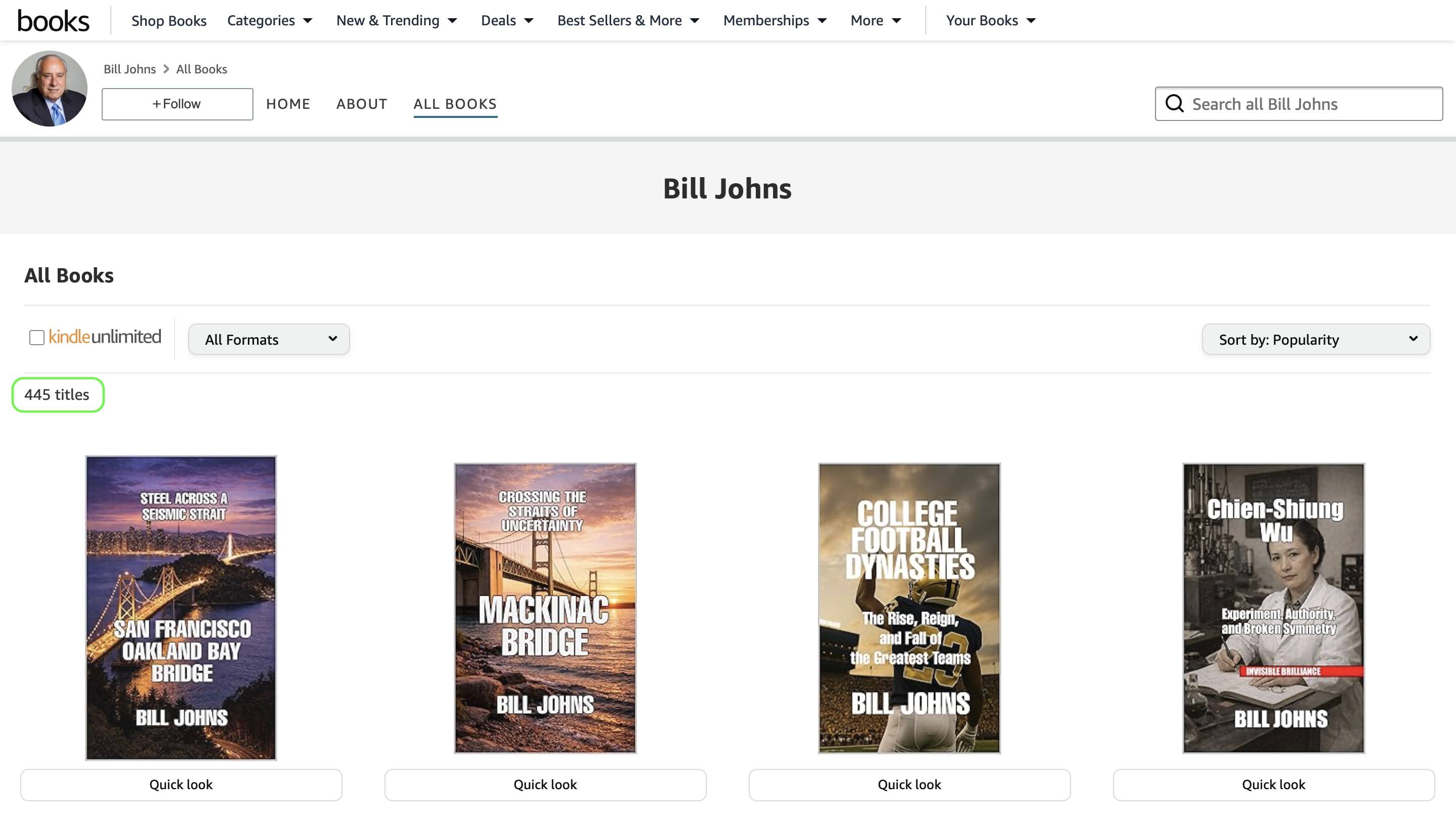
Bill Johns’s Amazon author page. In a single year he published 445 books — on everything from cybersecurity and… bridges to sports, biography, and philosophy. Source
That impressive number includes, for instance, a 13-book cybersecurity series, which, alongside the aforementioned history of hacking, contains the following titles:
- The Cybersecurity Blueprint: Building and Operationalizing a Complete Defensive Strategy
- Hardware Fortress: The Role of Data Diodes in Protecting Critical Infrastructure
- Zero Trust: Redefining Security in a Perimeterless World
- Evolving Threats, Evolving Chains: Cybersecurity for the Modern Supply Chain
- The Integration Imperative: Cybersecurity for Legacy OT/ICS: Overcoming the Challenges of Digital Transformation in Critical Infrastructure
Cybersecurity turned out to be far from the only — or even the main — subject on this prolific author’s mind. Beyond it, Bill Johns’s body of work covers sports, bridges, alcohol of every kind (sake, whiskey, you name it), biographies of notable figures, military aviation, and philosophy. In short, t’s hard to think of a topic Johns hasn’t written a book about yet.
Johns’s “creative process” involves planning out a book’s chapters with ChatGPT and then gradually writing each one. As Johns himself puts it, asking the AI to generate an entire chapter in one go doesn’t work very well (shocking, I know), so it’s better to write the text piece by piece. When needed, he asks ChatGPT to make revisions. After publishing, he buys a copy of each of his 445 books on Amazon — but only to put on the shelf, since reading them likely isn’t the point. As Johns sees it, he read his books while they were being generated, and that’s good enough.
This literary titan’s goal is to generate 10 books a week — which happens to be the maximum Amazon allows within that timeframe (just three years ago, that limit was twice as high). That said, unlike the author behind Kashmir Hill’s biography, Johns’s books tend to run considerably longer.
The finishing touch on this self-publishing workhorse’s portrait is, well, his portrait that appears on his Amazon author page and on the back cover of every one of his books. Johns doesn’t hide the fact that this picture is also AI-generated, and explains the choice with characteristic practicality and bluntness: “It was either that or put on a suit and take selfies.”
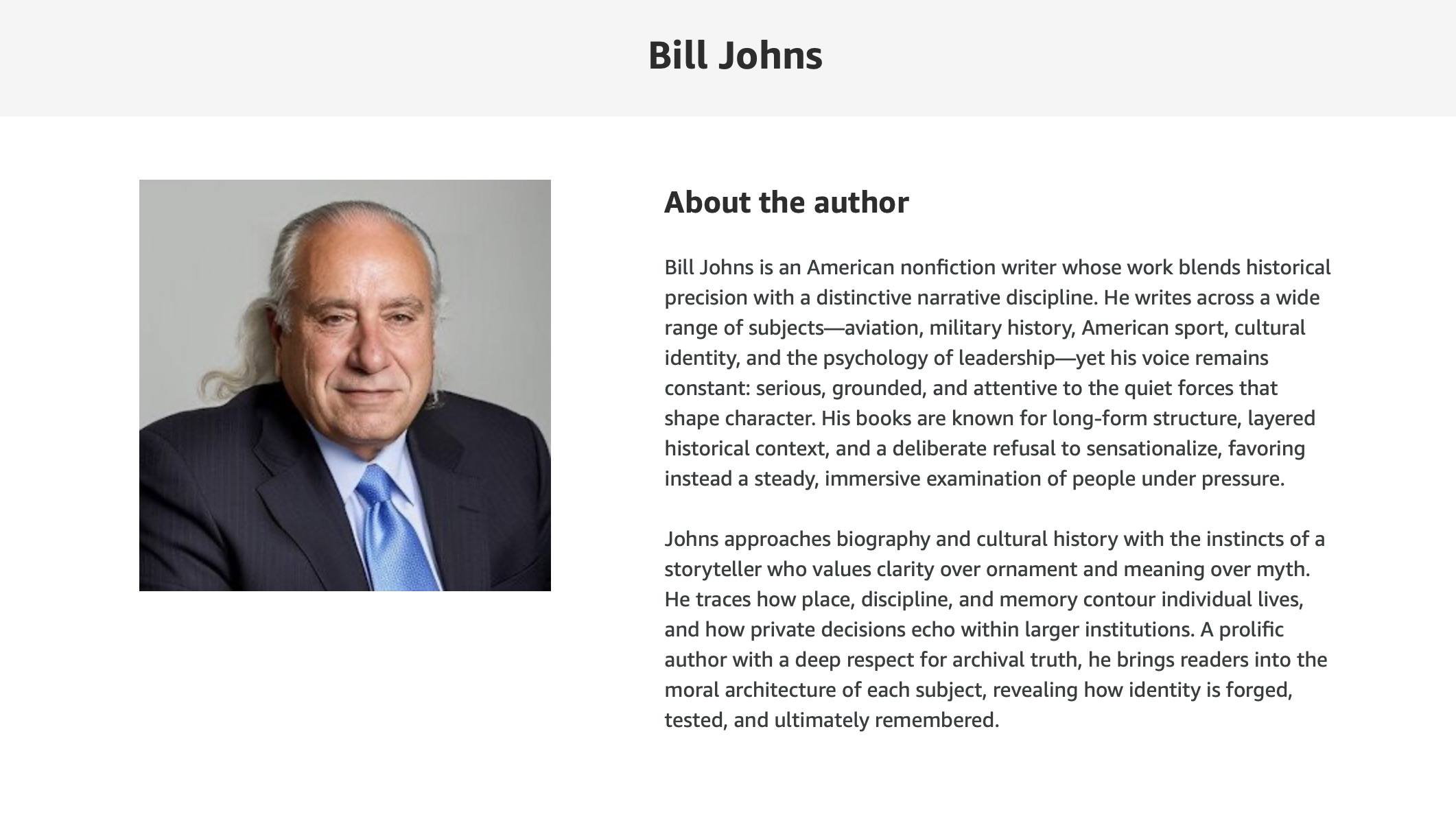
Even his own author photo Johns left to AI — dressing up and taking a selfie was apparently too much like hard work. Source
The economics of AI Wonderland: curiouser and curiouser
Any reasonably clear-eyed reader is bound to wonder: why do Bill Johns and other makers of AI books bother with this at all, and on this kind of scale? Sure, you could “write” one book just to link it in your resume, proudly slap “Amazon author” onto your social media bios, and tell strangers at bars you’re a writer. Maybe, just to be safe, you crank out a couple more. But why generate 400+ books?
The answer lies in the economic model Amazon built long before AI ever appeared on the scene. Unlike traditional publishers, Amazon doesn’t print a run in advance. Most books published through Kindle Direct Publishing follow a print-on-demand model: a physical copy only gets printed once a customer actually orders it from Amazon.
That’s how an author can put out a book with almost no upfront cost. And, crucially, without the risk of unsold copies — copies that have already been paid for and printed — piling up in a warehouse. In other words, listing hundreds of books in the online store costs Amazon, and the author, next to nothing.
With investment costs sitting near zero, even modest demand can generate real profit. Bill Johns, for instance, sells a few hundred books a month to unsuspecting readers. During one holiday season (December to early January), he says, sales hit 821 copies — earning him nice little boost to his retirement income: around US$6000.
Some AI books make their authors even more money. Take the AI-generated biography of American political activist Charlie Kirk, which became an Amazon bestseller after his assassination. Readers weren’t happy with it, and after dozens of reviews containing words like “mind-numbing”, “scam”, and “a disgrace”, Amazon pulled the book from the platform. Regardless, the service likely sold thousands of copies of the biography before that happened — turning a hefty profit for both Amazon and the author.
How to tell a raven from a writing-desk
In a world saturated with AI, how to tell human-made from machine-made is becoming all the more pertinent. And Amazon is far from the only online marketplace actively fueling the spread of AI slop, so there’s every reason to expect it’ll only get worse.
To save yourself from wading through another chatbot’s uninspired hallucinations, we recommend turning to trusted sources for anything that actually matters. When it comes to cybersecurity expertise, for instance, our blog is a solid place to start. Unlike some super-productive retired consultants, we write every word ourselves — and stand by all of them.
For more on cybersecurity in books and film, check out our other posts: